Key Takeaways
- This story uses isolation, weather, and repeated sound to make a simple knock feel impossible to ignore.
- The lighthouse setting works because duty forces the keeper to stay where most people would flee.
- The scariest detail is not the ghost itself, but the uncertainty of whether the knocking is human, memory, or warning.
- Readers can use the included tension table and story tool to understand why the scene feels so unsettling.
- The ending leaves room for interpretation without abandoning the emotional truth of the keeper’s choice.
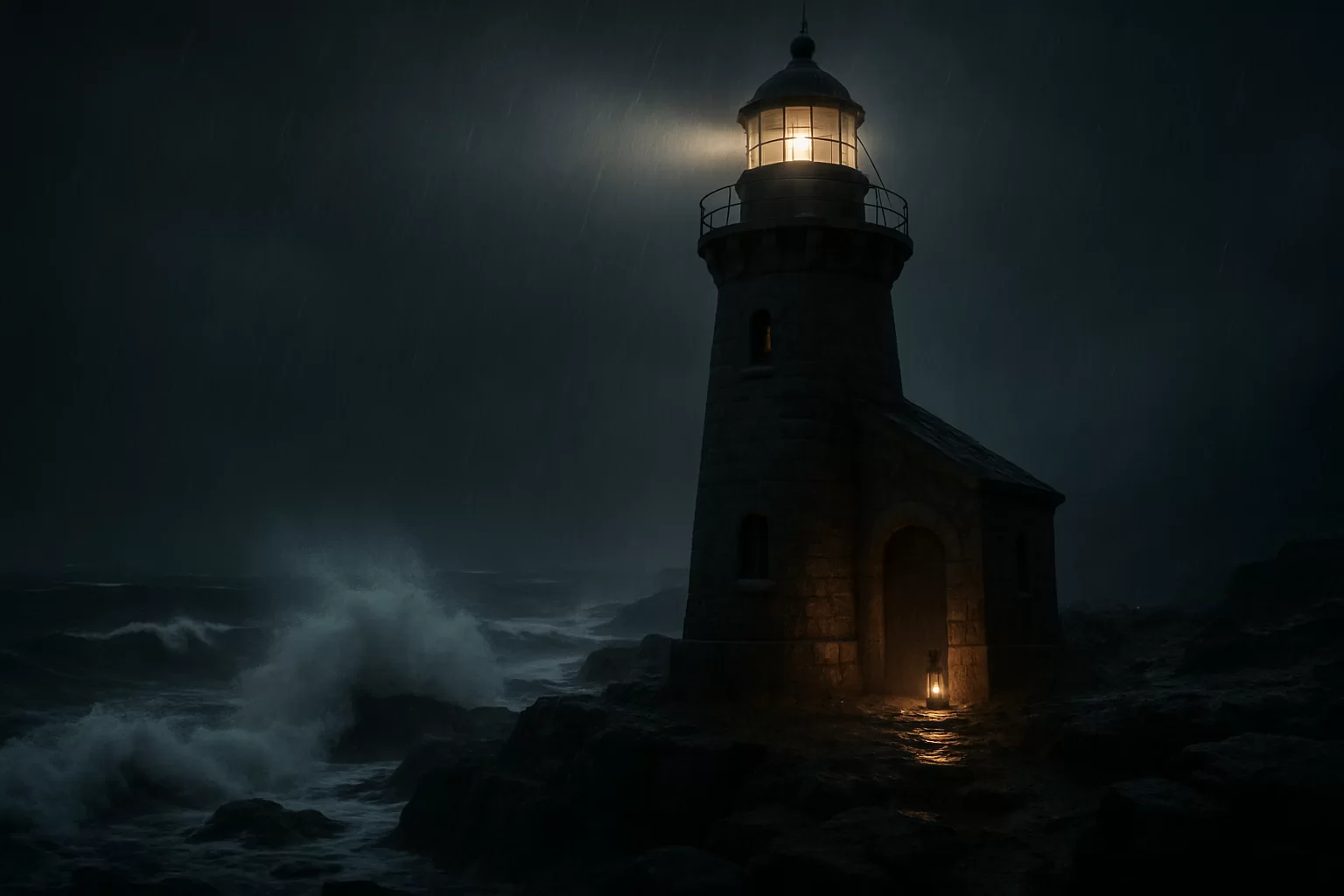
The lighthouse keeper who heard knocking was not the sort of man who believed every creak was a spirit. Elias Rowe had lived through winter gales, broken lamps, spoiled oil, and the long conversations a lonely mind can hold with itself.
That is why the first knock did not frighten him. The second made him pause. The third, coming from the seaward door while the tide hammered the rocks forty feet below, made him set down his cup without drinking.
Quick Answer
The lighthouse keeper who heard knocking is a scary sea story about Elias Rowe, a solitary keeper on a storm-lashed tower who hears impossible knocks at midnight from outside a door no living person could reach. As the sound returns in a pattern tied to an old shipwreck, Elias must decide whether to obey duty, fear, or compassion. The story is effective because it makes the threat small and specific: not a monster crashing through the walls, but a patient presence asking to be let in.
Personal Action Builder
Answer four quick questions and get a practical next step based on this guide.
Choose the options above, then build a recommendation you can use with the checklist, table, and sources in this guide.
In This Guide
The Lighthouse Keeper Who Heard Knocking
On the last night of October, the sea around Wren Point turned the color of iron. It struck the reef in white explosions and came apart under the lighthouse windows as if the world were grinding its teeth. Elias Rowe trimmed the lamp at dusk, checked the clock, wrote the pressure in the log, and noted the same warning he had written since noon: no vessel should attempt the channel.
Wren Point Light stood on a stack of black stone joined to the mainland only at the lowest tides. The causeway disappeared by evening. By night, there was no road, no beach, no neighbor’s lantern, only the round tower, the keeper’s room, and the sea throwing itself at the door below.
A lighthouse is safe and unsafe at once. Its walls protect the keeper, but its purpose keeps him exposed to the very weather that threatens him.
Knocking is intimate. Unlike thunder, it suggests intention. Someone, or something, knows there is a person inside and expects an answer.
Elias is not a thrill-seeker. He is a working man with procedures, habits, and a duty to keep the lamp burning.
The story delays the face at the door. That restraint lets the reader’s imagination do work no description could match.
Elias had kept Wren Point for nine years. He knew every honest sound in the tower: the tick of the regulator clock, the sigh of wind under the lantern room, the mouse behind the flour bin, the soft complaint of wet rope shrinking near the stove. When a stone shifted in the foundation, he could name the corner before the echo died.
So when the knock came, he knew it did not belong.
It was not loud. Three measured taps sounded from the lower door, the one that opened toward the landing steps. Elias lifted his head from the logbook. Rain crossed the small window sideways. The tide was full. Nobody could stand on those steps. At full tide, there were no steps.
He waited. The clock clicked. The lamp burned above him. A gust pressed the tower until the walls hummed, and then the knock came again: three taps, patient as a hand on a parlor door.
Elias took the storm lantern and descended the spiral stairs. He moved slowly, partly because the stairs were slick with damp, partly because the sensible part of him wanted time to build an explanation. Driftwood, he thought. A loose shutter. A rope-end thrown by the surf. Perhaps the hinge strap had loosened and was striking the frame.
At the bottom, the iron latch was cold beneath his fingers. The seaward door shuddered with each wave impact, but not in the rhythm of the knock. Elias held the lantern high. Water seeped under the threshold in thin black threads. Then, from the other side, something tapped once. Not three times. Once. As if it knew he was there.
He stepped back.
There were rules for keepers, and most had been written because some dead man had failed to follow them. Do not open the outer door in a gale unless the landing is visible. Do not leave the lamp unattended. Do not trust voices in storm weather; wind makes beggars, captains, and children of itself. Elias had copied those rules into the front of his log when he arrived as a younger man with stronger knees and fewer memories.
The single tap came again, lower this time, near the threshold.
“Who’s there?” Elias called, and regretted it immediately. His own voice came back small and ordinary. The tower seemed to listen with him.
No answer.
He climbed back to the keeper’s room and shut the trap behind him. For the next hour he worked because work was a kind of courage. He checked the flame, wiped condensation from the glass, wound the mechanism, and wrote in the log: 11:47 p.m. Unusual sound at lower seaward door. Cause unknown. Sea too high to inspect.
At midnight, the knocking returned, but now it came from above.
Three taps sounded on the trapdoor beneath his boots.
Elias did not move. The stairs below were empty; he had latched the lower door. Yet something had either entered the tower without opening it, or else the sound was no longer outside at all. The trapdoor trembled, just enough to ripple the spilled tea in his cup.
Tap. Tap. Tap.
His first thought was of his brother, Jonah, though Jonah had been dead twenty-one years. Jonah had gone down with the trawler Mercy Lane before Elias took the keeper’s post. The bodies of six men washed ashore. Jonah’s did not. Their mother had spent one winter insisting she heard him knocking at the back of the family cottage, too polite to enter without being invited.
Elias had hated that memory because it made grief sound foolish. Now, inside the lighthouse, he understood the cruelty of a door. A door gives hope a shape. It says someone might be on the other side.
He opened the trapdoor with the poker.
The stairwell below was empty. His lantern light fell in a yellow spiral down the wet stone. No face looked up. No hand withdrew. Only a smell rose from the dark, sharp and briny, like seaweed left too long in a closed room.
Then a voice spoke from the lower landing.
“Keeper.”
Elias gripped the poker until his knuckles ached.
The voice was not Jonah’s. It was younger, hoarse, and waterlogged, as if each syllable had been brought up from the bottom. “Keeper, the light.”
Above Elias, the lamp still burned in its great glass cage. Its beam swept the storm in pale intervals. Once every rotation, the room brightened and went dim again, brightened and went dim again, like a slow heartbeat.
“The light is burning,” Elias said.
“Not for us.”
The answer loosened something in him. Not fear; fear was already there. This was recognition. Wren Point had eaten ships before the lighthouse was built, and after it too. Every keeper learned the names: Mercy Lane, Dulcibella, North Star, Anne of Leeds. But there was one wreck Elias had never liked to read aloud. The school packet Alder Finch had struck the reef fifty years earlier in a fog, carrying eleven children from the island to the mainland. Only the teacher survived, half mad, saying the children had knocked from inside the overturned hull until the sea grew quiet.
Elias had always thought the story too cruel to be useful. Cruel stories often become local history because people are afraid to forget them.
The trapdoor knocked beneath his hand.
“Keeper,” the voice said again. “Open.”
Elias looked at the logbook. He looked at the lamp. Duty said he should stay where he was. Pity said he should go down. Fear said nothing useful; it only filled the room, thick as smoke.
He took the lantern and descended.
Halfway down, the knocks began around him. They sounded from the walls, from the stair treads, from behind the oil cupboard, from the iron-rimmed porthole sealed for winter. They were not frantic. That was the worst of it. They were polite, orderly, almost hopeful. The tower had become a house full of guests waiting to be received.
At the bottom, the seaward door stood closed. The latch had not moved. Elias lifted the lantern and saw wet handprints on the inside of the wood.
Small handprints.
He whispered a prayer he had not used since childhood, not because he expected rescue, but because the words gave his mouth something human to do. Then he placed his palm against the door. The knocks stopped.
For one breath, there was only storm.
“I cannot open it,” Elias said. “The sea will take the lamp.”
A child’s voice answered, closer than the wood, close enough to be inside his ear. “Then remember us.”
The latch lifted by itself.
Elias threw his weight against the door, but it did not swing outward. It opened inward, as no such door should, and a wash of black seawater poured across his boots. In that water he saw pale shapes: fingers, ribbons, a slate pencil, a button from a school coat, and a face that might have been any child’s if grief had not made it all children’s at once.
The lamp above stuttered.
Elias ran. He slammed the door, barred it with the storm beam, and climbed faster than his old knees allowed. The flame in the lantern room had dipped, starved by a draft that should not have reached it. He trimmed the wick, shielded it, coaxed it back until the beam steadied over the reef.
Outside, through a break in the rain, he saw them.
Not bodies. Not exactly. A line of small dark figures stood where no footing existed, shoulder to shoulder on the boiling water below. They faced the tower. When the light swept across them, each lifted one hand and knocked, not on wood, but on the air.
Tap. Tap. Tap.
Elias did not open the door. He did not look away either.
All night he kept the light burning. All night the knocking moved with the beam, circling the tower, tapping at every window it passed. Near dawn, when the storm began to spend itself, the sound softened. One by one, the small figures faded into rain.
At 5:12 a.m., Elias wrote the final line of the night’s entry: Heard knocking. Kept light. Remembered.
The relief keeper found him at noon sitting by the cold stove, coat still wet, one hand wrapped in a child’s blue ribbon. Elias never explained where it came from. He resigned before winter. Years later, when he died inland in a house with no view of the sea, the nurse on duty said he woke shortly before midnight and asked if the lamp was lit.
She told him yes, though there was no lamp in the room.
He smiled then, as if someone had finally stopped knocking.
Why This Lighthouse Knocking Story Feels So Unsettling
The lighthouse keeper who heard knocking works because the danger begins as a problem of interpretation. Elias is not chased at first. He is asked to decide what the sound means. A knock can be rescue, warning, accusation, or invitation, and every possibility carries a cost.
Isolation sharpens that uncertainty. In a town, Elias could ask a neighbor to listen. In a lighthouse, he must become witness, judge, and survivor at the same time. That pressure makes the haunting feel intimate rather than theatrical.
| Element | Story use | Fear created | Reader question |
|---|---|---|---|
| Storm | Blocks escape | Trapped feeling | Can he leave? |
| Knocking | Repeats calmly | Intentional presence | Who wants in? |
| Rules | Forbid opening | Moral conflict | What is right? |
| Children | Reveal grief | Protective dread | Can memory help? |
| Lamp | Must stay lit | Duty under fear | What must remain? |
There is also a practical reason the setting holds attention. Historic offshore lights, such as the well-known Eddystone Lighthouse, remind us that these towers were built in places where ordinary shelter was impossible. The architecture itself says: someone had to stand here when the sea was at its worst.
The fear is not only supernatural. Modern psychology describes fear as a response that prepares the body for threat, even when the threat is uncertain. A repeated knock in darkness is perfect fuel for that response because it gives the mind just enough information to imagine the rest.
A Simple Knocking Tension Tool for Scary Stories
If you enjoy reading or writing scary stories, use this quick tool to see why a scene is working. A knock becomes frightening when it violates a rule the reader understands: wrong place, wrong hour, wrong rhythm, wrong side of the door, or wrong knowledge.
For the strongest effect, add one violation at a time. If the first knock is already impossible, bloody, screaming, and fully explained, the scene has nowhere to climb. Let ordinary reality hold for a moment before you bend it.
Put the knock where no visitor can stand: a sealed room, a high window, a submerged door, or a locked cellar wall.
Use an hour associated with vulnerability. Midnight works, but so does the minute after a funeral or the moment a storm cuts power.
A pattern suggests intelligence. Three knocks, a pause, then one answer can feel more disturbing than random banging.
Let the presence know something private: a name, a childhood prayer, an old guilt, or a promise the character broke.
Reader check: When a scary scene feels flat, ask what choice the character must make. Fear grows when opening the door and refusing the door are both dangerous.
Mistakes to Avoid When Reading or Writing Sea Horror
Sea horror can become vague if every strange event is blamed on fog, madness, or “something ancient” without emotional stakes. The ocean is already vast; the story needs a small human anchor. In this tale, the anchor is Elias’s duty to the lamp and his unresolved relationship with loss.
Another common mistake is showing too much too soon. A door, a sound, and a rule can carry more suspense than a full apparition. Let the reader understand the geography, the danger, and the keeper’s limits before the haunting becomes visible.
Leave space for mystery, but make the emotional situation clear. Readers can accept ambiguity when the character’s fear and choice make sense.
Know where the doors, stairs, light, and tide are. Clear physical details make impossible events more convincing.
Suspense needs escalation. Start with sound, then evidence, then voice, then sight, rather than presenting everything at once.
A good haunting changes someone. The strongest final note shows what the night cost, not only what appeared.
For readers choosing a scary story to share aloud, this one works best in a quiet setting with pauses after each set of knocks. Avoid reading it too quickly. The dread lives in the waiting, not just in the reveal.
If you are sensitive to stories involving lost children or drowning, treat that as a valid reason to skip or save the tale for another time. Horror should challenge the imagination, not force readers through material they do not want.
Summary and Final Thoughts
The lighthouse keeper who heard knocking is a compact ghost story about duty, grief, and the terror of being asked to open a door during the worst possible hour. Its power comes from restraint: a repeated sound, a dangerous tide, and a man who cannot simply run.
The ending matters because Elias does not defeat the haunting in a grand way. He keeps the light, remembers the lost, and survives changed. Sometimes the most haunting stories are not about escaping fear, but about answering it without surrendering what must be protected.
FAQ
Is The Lighthouse Keeper Who Heard Knocking based on a true story?
This version is original fiction, not a verified historical account. It draws on real lighthouse isolation, maritime danger, and coastal folklore traditions to create a believable atmosphere, but Elias Rowe and the events at Wren Point are fictional.
What makes knocking so scary in ghost stories?
Knocking feels personal because it implies intention. A storm can be random, but a knock suggests someone knows you are inside. When the sound comes from an impossible place, the mind tries to explain it and fear fills the gap.
Why does Elias refuse to open the door?
Elias refuses because opening the seaward door during a full storm could flood the tower, extinguish the lamp, and endanger any ships nearby. His choice is painful because compassion pulls him toward the door while duty keeps him inside.
What does the blue ribbon mean at the end?
The ribbon is a physical trace of the haunting and a symbol of remembrance. It suggests Elias did not merely imagine the night, while still leaving room for mystery about whether the children were ghosts, memories, or something older.
How should I read this story aloud for maximum suspense?
Read slowly, especially around the repeated knocks. Pause after “Tap. Tap. Tap.” and let silence do some work. Keep your voice steady rather than dramatic; the story is more unsettling when Elias sounds controlled while the situation becomes impossible.